Budget 2026 Explained in Simple Language | What Government Earns, Spends & Borrows
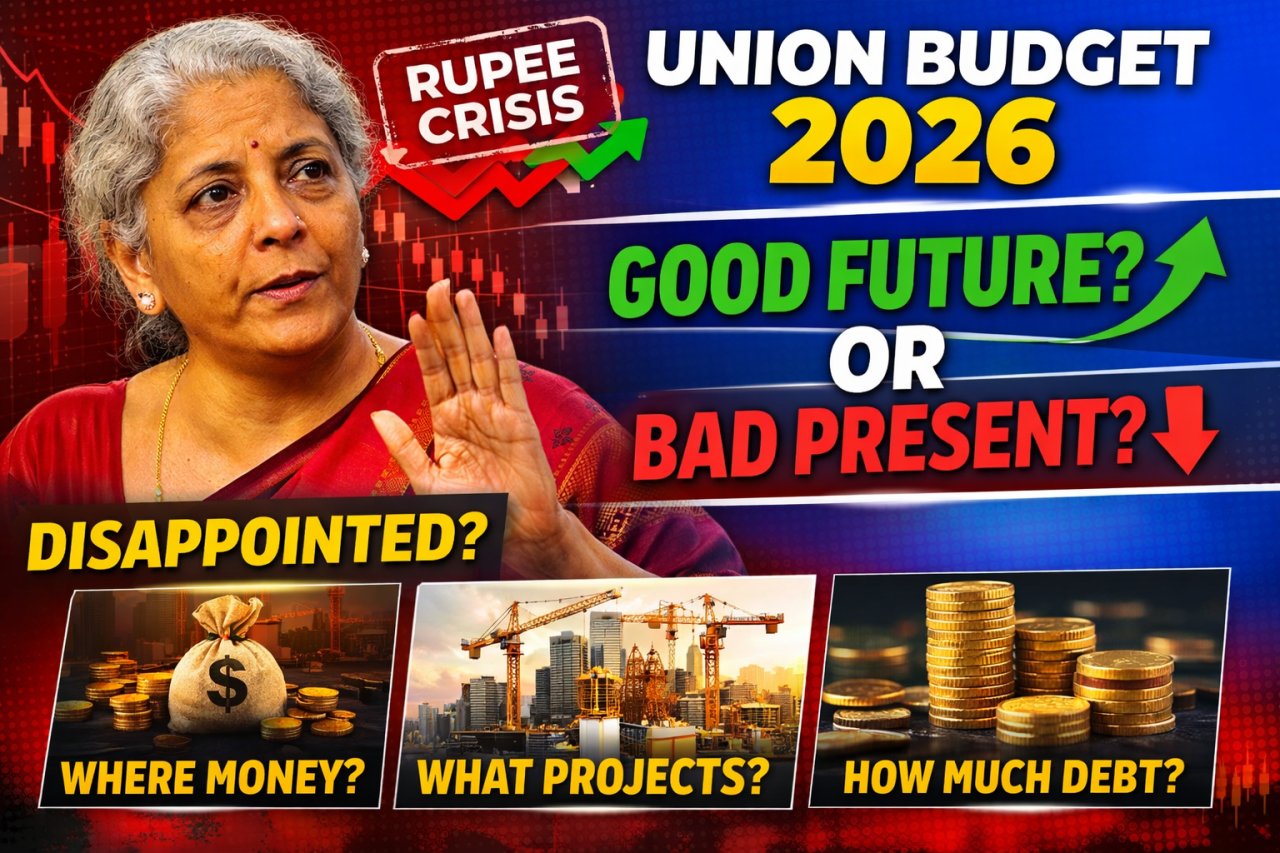
Union Budget 2026 Explained Simply: What It Really Means for You and India
A simple, honest, and no-nonsense breakdown of Budget 2026 — beyond noise, markets, and politics.
This year, expectations from the budget were almost zero for many middle-class Indians. No major tax relief. No big announcements that immediately make life cheaper. Instead, what people noticed was higher taxes, market volatility, and the sense that “nothing was done for us.” On budget day itself, markets slipped sharply, reinforcing the feeling that something went wrong.
But here’s the uncomfortable truth: this budget is very different from the last few budgets. It is not designed to make you happy today. It is designed to change the country tomorrow.
Why 1st February Matters
1st February is one of the most important days for India. On this day, the Finance Minister presents a single document that answers three powerful questions:
- Where will the government earn money from?
- Where will the government spend money?
- What is the government’s vision for economic growth?
If you understand these three things, you automatically become a more informed, responsible citizen. Contrary to popular belief, you don’t need to be an economist or a CA to understand the budget. You just need the right perspective.
The Family Budget Analogy
Think of India as a large joint family. Every family member earns differently and contributes to the household. At the start of the month, everyone submits their income to the person managing expenses — just like citizens pay taxes to the government.
During dinner, everyone expresses their needs. One wants a vacation, another has wedding expenses, someone wants house repairs. But money is limited. So priorities must be decided.
That is exactly what a budget is. Citizens have unlimited demands, but the government has limited money. The job of the government is not to make profit — it is to choose what is urgent and what can wait.
Types of Budgets
There are three kinds of budgets:
- Surplus Budget: Income is more than expenditure.
- Balanced Budget: Income equals expenditure.
- Deficit Budget: Expenditure is more than income.
A surplus budget is unrealistic for a developing country like India. A balanced budget is impractical. A deficit budget is necessary — but only if it is controlled.
Last year, India earned about ₹34.9 lakh crore but spent over ₹50.6 lakh crore. The gap is covered through borrowing, which becomes national debt.
Where Does India’s Money Come From?
If India earns ₹1, this is roughly how it is sourced:
- Income Tax – 21 paise
- Corporate Tax – 18 paise
- GST & Other Taxes – 18 paise
- Union Excise – 6 paise
- Customs Duty – 4 paise
- Non-Tax Revenue – 10 paise
- Borrowings – 24 paise
Even after paying taxes, India does not earn enough to meet all expenses. Borrowing is unavoidable. This is why tax evasion does not hurt the government — it hurts the country.
Where Does the Government Spend?
The biggest expenditure is interest payment on past loans. Defence, roads, railways, food subsidy, rural development, fertilizers, agriculture, and education follow.
A major highlight of Budget 2026 is capital expenditure — money spent on building assets like highways, railways, power plants, and infrastructure that generate long-term growth.
Long-Term Vision of Budget 2026
This budget consciously avoided freebies and short-term popularity. Instead, it focused on:
- Textile sector revival to counter global trade pressures
- Rare earth corridors in southern and eastern states
- High-speed rail corridors across major cities
- Medical tourism hubs and tourism infrastructure
- Mental health institutions and regional hubs
None of these will show results in one year. But if executed properly, they can transform India’s economic competitiveness over the next decade.
Capital vs Revenue Expenditure
Capital expenditure creates assets — like building hospitals, buying fighter jets, or installing railway signaling systems. Revenue expenditure repeats every year — salaries, subsidies, pensions.
A healthy budget increases capital expenditure gradually while controlling revenue expenditure. Budget 2026 clearly pushes more money towards capital creation.
The Real Concern: Execution
India does not suffer from lack of plans. India suffers from lack of execution. Announcements mean nothing if ministries fail to implement reforms effectively.
Whether it is road safety, education quality, export competitiveness, or space research — execution will decide whether Budget 2026 becomes visionary or wasted.
Final Thoughts
Budget 2026 is not an emotional budget. It does not flatter the middle class. It does not excite investors immediately. But it is a serious attempt at long-term nation building.
As citizens, our job is not just to complain — but to understand, question execution, and demand accountability. A budget is not the end. It is the beginning.