YouTube Algorithm 2026: Why Subscribers, Views & Watch Time Don’t Matter Anymore (And How to Go Viral Now)
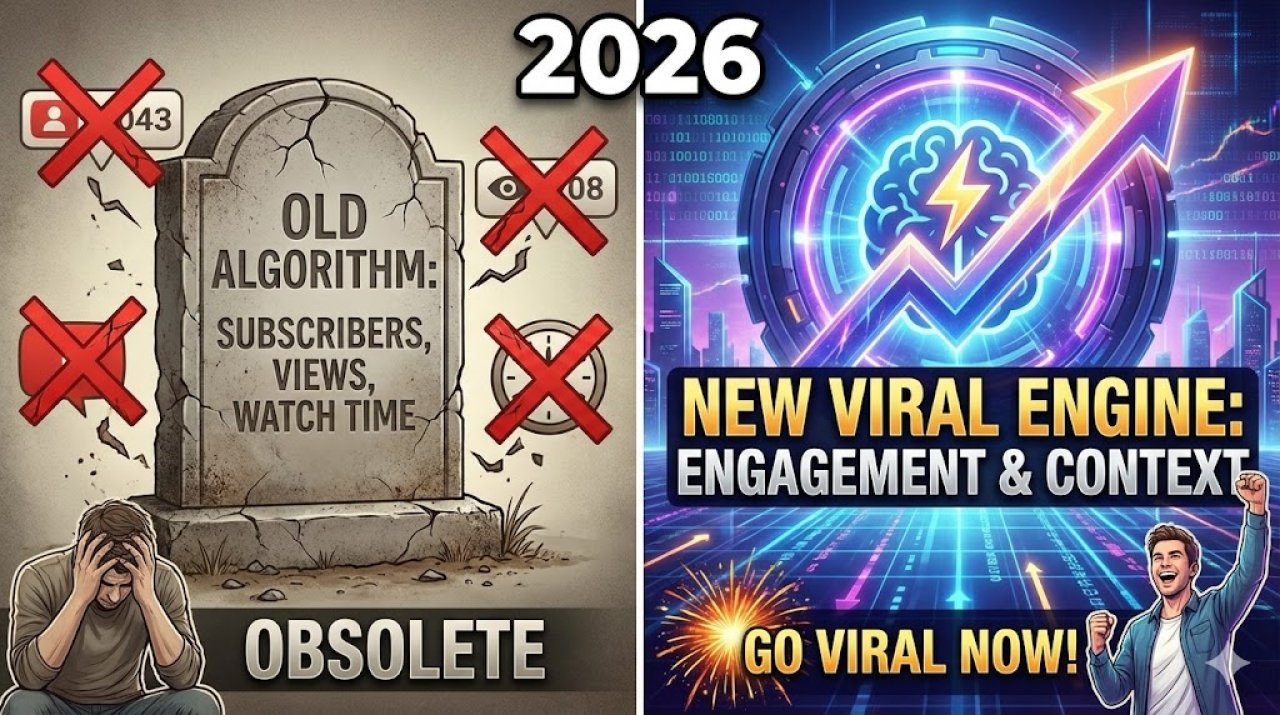
“Subscribers don’t matter.”
“Views don’t matter.”
“Even watch time doesn’t matter anymore.”
If that sounds shocking, welcome to YouTube in 2026.
YouTube has completely transformed its algorithm. And if you’re planning to become a YouTuber — or already struggling to grow — understanding this shift is not optional.
The old growth tactics are outdated.
In this blog, you’ll learn:
-
What changed in the YouTube Algorithm 2026
-
Why Gemini AI has changed ranking forever
-
Why session time beats watch time
-
What emotional retention really means
-
How the new testing cycle works
-
The 3 growth levels you must pass
-
Why you must start building “Shows” like TV
Let’s break it down.
1. Search Adaptability: Gemini Has Changed Everything
Earlier, ranking on YouTube was mechanical.
You had to:
-
Add keywords in title
-
Fill description with keywords
-
Add tons of tags
SEO was metadata-driven.
But in 2026, YouTube integrated Gemini AI deeply into its system.
Now ranking is context-based.
Gemini understands:
-
Topic intent
-
Context of your script
-
Language tone
-
Viewer behavior patterns
This means:
You can write a clickbait title.
But if your content doesn’t match user search intent — your video will not rank or get suggested.
Now YouTube asks:
“Does this video truly answer what the user is searching for?”
If not — impressions drop.
What You Must Do Now:
-
Create highly specific content
-
Stay focused on one topic per video
-
Match search intent clearly
-
Remove fluff
-
Stay to the point
If AI cannot understand who your target audience is — your video is dead before it starts.
2. Session Time > Watch Time
For years, creators chased watch time.
“Make videos longer.”
“Increase retention.”
“Get 50% average view duration.”
But 2026 has shifted priority.
Now:
Session Time is greater than Watch Time.
Let’s understand the difference.
-
Watch Time = How long someone watches your video
-
Session Time = How long someone spends on YouTube because of you
If someone watches your full 20-minute video but leaves YouTube after that — limited value.
But if someone:
-
Opens YouTube because of you
-
Watches your video
-
Watches more videos
-
Comes back weekly
YouTube rewards that creator more.
Why?
Because YouTube wants to maximize total platform time.
So even if you have:
100,000 views
But another creator consistently brings viewers weekly — even with 10,000 views — YouTube may support them more.
Session builders win.
3. Emotional Velocity: The New Retention
Here’s the most misunderstood shift.
Audience retention alone is not enough.
Now YouTube analyzes emotional retention.
What does that mean?
If viewers:
-
Don’t feel excitement
-
Don’t rewind moments
-
Don’t pause to absorb
-
Don’t react emotionally
Your content becomes flat.
You can check this using the audience retention graph.
If your graph is flat with no spikes — emotional impact is low.
Spikes indicate:
-
Replay moments
-
Surprise
-
Shock
-
Learning peak
-
Emotional reaction
In 2026, emotional velocity matters more than passive retention.
You must create spike moments.
Understanding the Old vs New Algorithm
Old Algorithm (Simplified)
-
You upload video
-
YouTube pushes to seed audience (based on metadata)
-
People click based on thumbnail/title
-
Watch time & engagement analyzed
-
If metrics good → video pushed wider
Simple growth loop.
New Algorithm (2026 Model)
Now the flow looks like this:
Step 1: AI Analysis
Gemini studies:
-
Context
-
Topic
-
Intent
-
Language
-
Viewer behavior match
Subscribers do not matter here.
Your video goes to people who are actively searching or showing interest in that topic.
Step 2: First Testing Cycle
Three metrics analyzed:
-
CTR (Click Through Rate)
-
Viewer Satisfaction
-
Watch Time
If:
-
Title promises A but video delivers B → satisfaction drops
-
Watch time low → reduced distribution
Fail here → content slowly dies.
Pass → move to next level.
Step 3: Advanced Testing Cycle
Now YouTube analyzes:
-
Return Viewer Rate
-
Emotional Retention (spikes)
-
Session Time
If your video:
-
Doesn’t create returning audience
-
Doesn’t generate spike moments
-
Doesn’t increase session duration
Your growth becomes stagnant.
If you pass this stage — viral potential increases.
How to Grow with the New Algorithm (3 Levels Framework)
To simplify this, let’s divide growth into 3 levels.
Level 1: Initial Impressions
Goal: Help Gemini understand your audience.
Focus on Content Consistency.
Not upload frequency.
Topic consistency.
If you are a new channel:
Stick to one sub-topic.
Example:
Instead of:
-
One video on crypto
-
One on AI
-
One on fitness
-
One on motivation
Choose:
-
Only AI tools for beginners
This helps AI clearly categorize your channel.
If Gemini is confused — impressions reduce.
Clarity = Distribution.
Level 2: Initial Views
Now you must win Viewer Satisfaction.
Stop using misleading clickbait.
In 2026, clickbait kills channels.
Your packaging must match delivery.
Viewer should think:
“I got exactly what I expected.”
Also improve scripting:
-
Remove boring parts
-
Reduce repetition
-
Increase pace
-
Deliver value early
You cannot afford slow intros anymore.
Bored audience = Dead reach.
Level 3: Getting Viral
This is where 90% fail.
To cross this level, you need:
1. Series-Based Content
Create content people return for.
Examples:
-
Weekly breakdown show
-
AI Tools Friday
-
Startup Case Study Series
-
Growth Audit Series
One-off videos don’t build session time.
Series build habit.
2. Emotional Retention Scripting
You must learn:
-
Pattern breaks
-
Open loops
-
Surprise inserts
-
Strong storytelling
Create moments that:
-
Make people pause
-
Make them rewind
-
Make them screenshot
Increase spike density.
3. Publishing Consistency (Time-Based)
YouTube is shifting toward TV-style behavior.
Audience wants certainty.
If viewers know:
“Every Sunday 7 PM this creator uploads”
They open YouTube intentionally.
This increases session time — huge signal for algorithm.
The Biggest Strategic Shift: Start Making Shows
Why did YouTube shift algorithm?
Because TV audience on YouTube is increasing.
YouTube wants to become the new television.
Think about TV:
-
Fixed schedule
-
Known shows
-
Recurring format
-
Series model
That’s why large creators are:
-
Launching series
-
Running podcast formats
-
Creating episodic content
If you want to win in 2026:
Stop making random videos.
Start making shows.
Define:
-
Show name
-
Format
-
Duration
-
Upload day
-
Theme
When audience expects your content — you win session time.
Final Blueprint for 2026 Success
To win the new YouTube algorithm:
-
Make context-clear videos
-
Focus on search intent
-
Avoid misleading titles
-
Improve scripting pace
-
Create emotional spike moments
-
Build series content
-
Fix upload schedule
-
Increase return viewers
-
Think session time
-
Build like TV
Subscribers don’t control reach anymore.
Audience behavior does.
Views don’t control growth anymore.
Session dominance does.
Watch time alone doesn’t win.
Emotional impact does.
If you optimize for these new metrics — viral growth becomes predictable.
YouTube is no longer a video platform.
It is an attention ecosystem.
And in 2026, only strategic creators survive.